User Testing is business critical, when you work with CRO (Conversion Rate Optimization).
In order to turn more browsers into buyers in an E-commerce Store (CRO), it is essential both to work with Quantitive Data and Qualitative Data.
WHERE?
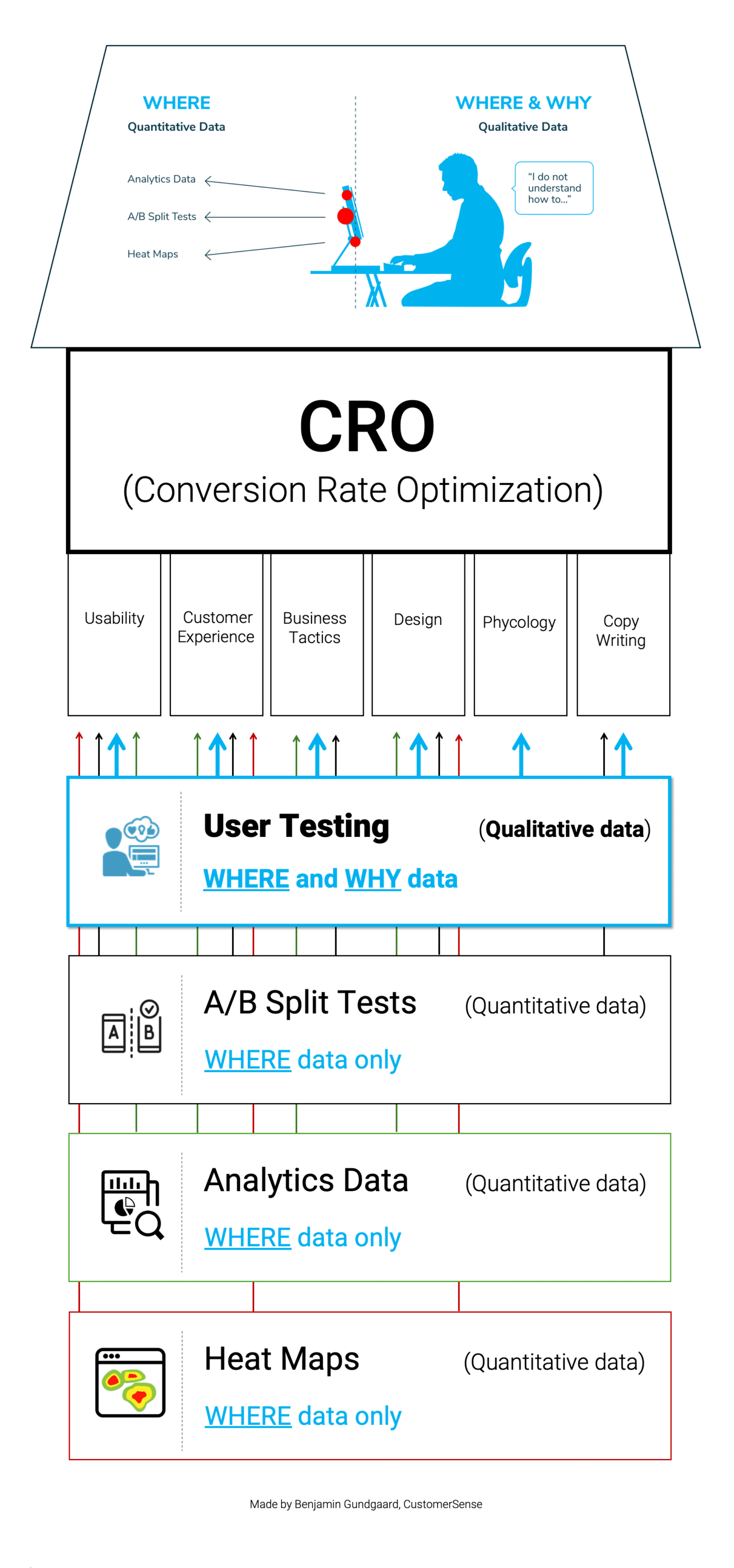
Quantitative Data helps you find out WHERE customers navigate, how far down the pages they scroll, if version A is better than version B, etc.
However; Quantitative Data cannot help you find out, WHY something is not working and HOW you can make it better.
WHERE and WHY?
To get the WHY you have to include your customers, by User Testing your E-commerce Store.
By doing so, you test all aspects of your E-commerce Store at once, while listening to your customers shop in it (The Think Aloud Methodology):
– Usability (How easy is it to use)
– The Customer Experience (How is it to shop)
– Business Tactics (Pricing, Bundles, Up-Selling, etc.)
– Design (Trust, Emotional Perception, etc.)
– Phycology (Cognitive, Behavioural, Emotional, etc.)
– Copy Writing (Usability, Scanning text, reading, text, etc.)
This opens a world of CRO knowledge you cannot find anywhere else.
When I carry out a User Test, I locate 75 – 100 issues, many of which makes it impossible for the customer to complete an order (Conversion Killers).
When you carry out a user test, you both will learn which issues you have to fix, but you also will get a lot of ideas for new features, business tactics, etc.
It is such an efficient tool.
The Data Mirror (Clusters)
Once you have carried out the User Test, you then can compare the findings with Quantitive Data sources, such as Analytics Data and Heat Maps. And, when you start optimizing your E-commerce Store, you can do A/B Split Tests of feature variations, now based on a solid amount of Qualitative Data.
A Good Optimization Process
In order to combine both Qualitative and Quantitative Data when optimizing your E-commerce Store, this thus is a good process:
1. User Test your E-commerce Store
2. Compare your Qualitative Data from your User Test with valid Quantitative Data Sources (Analytics, Heat Maps, etc.)
3. Optimize your E-commerce Store
4. User Test it on a development site before launching it and fix the issues you identify in your User Test
5. Launch
6. Do A/B Split Tests of feature variations, etc. (if needed).
A/B Split Tests Cannot Stand Alone
If you base your CRO process on A/B Split Tests only, you only test variations of WHERE (based on assumptions), but you will not get the WHY.
Or put into other words:
“You can spend your entire processional life A/B Split Testing, never to find the Conversion Killers. Or, you can do a User Test and find approximately 85% of all CRO errors in one day”.
I hope this elaborated post might help you in your CRO work.
Leave a Reply